Field note
The Portfolio Is Where Strategy Becomes Visible
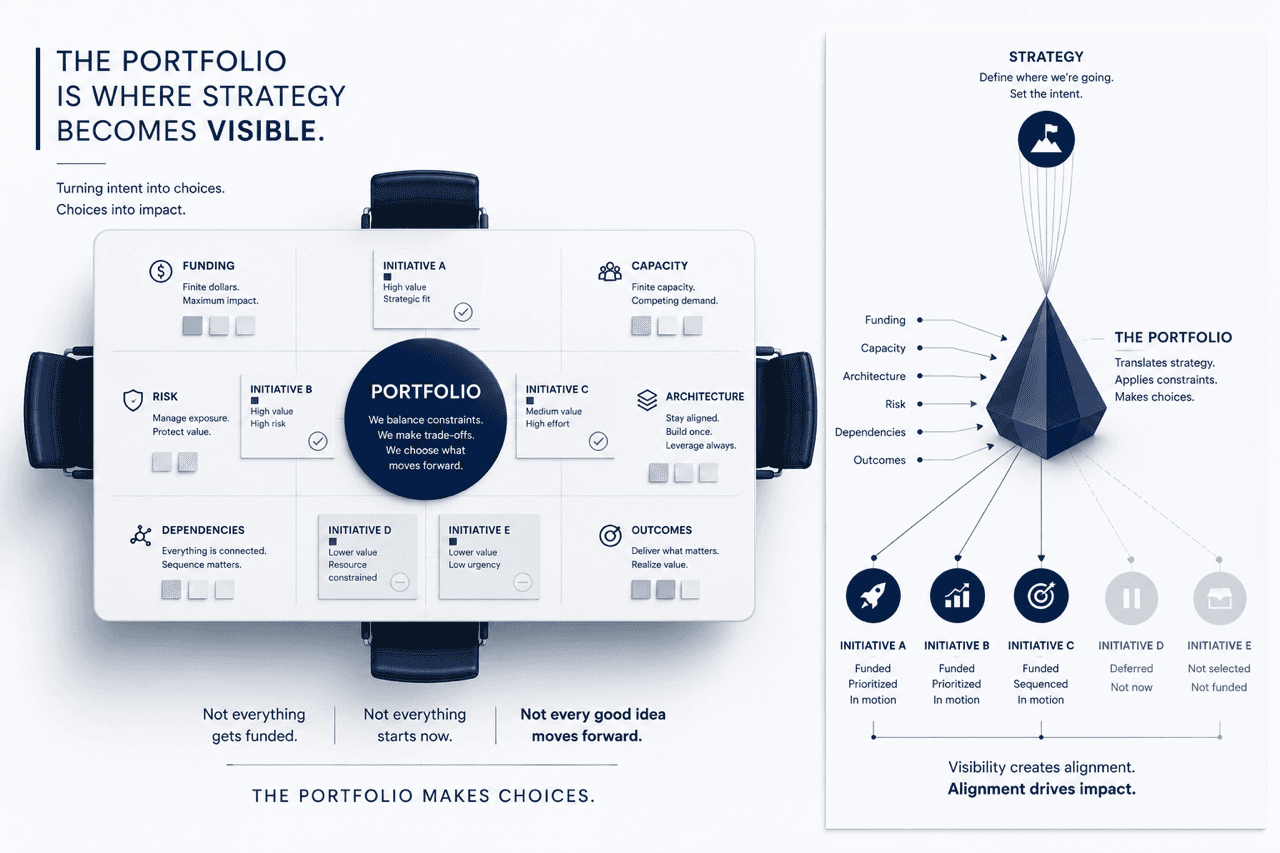
A portfolio is not a collection of projects. It is the management system through which strategy is translated into choices.

Strategy becomes credible when it is visible in the portfolio.
Strategy is often presented as priorities, ambitions, and future-state statements. Its practical meaning emerges in the portfolio. The portfolio shows what the organization is prepared to fund, sequence, protect, defer, and stop. It reveals whether leaders are making the trade-offs required to deliver a strategy or simply adding new expectations to an already overloaded system.
This is why portfolio management should not be treated as administrative coordination. It is an executive management discipline. A portfolio connects strategic intent and delivery reality. It allows leaders to see the combined demand on people, capital, data, technology, and decision-making capacity. Without that view, every initiative can appear reasonable in isolation while the organization becomes unable to complete the work that matters.
A portfolio is a system of choices.
The core work of portfolio leadership is deciding. Which outcomes deserve scarce capacity? Which dependencies need executive attention? Which initiatives are no longer aligned to strategy? Where has risk accumulated because the organization has committed to more change than it can absorb? These are not annual planning questions. They require a regular operating rhythm in which leaders use current evidence to act before delivery problems become institutional problems.
A useful portfolio view brings together more than schedules and budgets. It connects strategic outcomes, business capabilities, value streams, delivery confidence, risk exposure, workforce capacity, and architecture dependencies. Financial data shows commitment. Delivery data shows progress. Capability and architecture views show whether work is building a coherent future or adding another layer of complexity. Workforce data shows whether the organization can absorb the change being planned.
Business architecture gives the portfolio context.
Projects end. Capabilities remain. When a portfolio is organized only around project names, executives struggle to understand what is being strengthened, what is being duplicated, and where accountability sits after delivery. A capability view asks what the organization needs to be able to do better, who owns that ability, which processes and information support it, and how progress will be measured in operational terms.
This perspective is essential when portfolios include AI, modernization, operating model, and regulatory change at the same time. These initiatives often draw on the same data, leaders, subject matter experts, and delivery teams. A portfolio that cannot see the connections creates collisions. A portfolio that can see them can sequence work intelligently, resolve dependencies early, and make deliberate choices about where to build shared foundations.
Delivery excellence is a leadership responsibility.
Delivery confidence does not come from optimistic reporting. It comes from a willingness to make uncertainty visible. Leaders need to know what has changed, what evidence supports the forecast, which decisions are late, and where the plan depends on assumptions that have not been tested. The best portfolio reviews are working sessions focused on choices: what has to change, what must be protected, and what should stop. That discipline gives strategy a practical presence in the organization.
The portfolio is where strategy becomes visible because it is where intent meets constraint. It is where executive teams demonstrate whether they can align investment to outcomes, sustain focus through delivery, and make the difficult trade-offs that turn ambition into measurable progress.
A portfolio also makes organizational change visible. Every major initiative asks something of the workforce: new processes, new decisions, new information practices, new tools, or new accountability. When this demand is considered only project by project, the cumulative burden is easy to miss. A portfolio view allows leaders to identify where the same teams are being asked to absorb too much change and where sequencing can protect both delivery performance and organizational trust.
This is particularly important when the organization is pursuing AI adoption. AI initiatives should not be reviewed as a separate category of technology work. They should be considered alongside the data, process, governance, workforce, and operating model changes they depend on. The portfolio makes these dependencies explicit and helps executives decide whether they are investing in a durable capability or merely funding disconnected experiments.
Good portfolio practice is therefore a form of executive discipline. It creates a common language for outcomes, capacity, risk, and choice. It makes it harder to hide competing priorities behind optimistic plans. Most importantly, it provides a repeatable way for leadership teams to learn from delivery evidence and change course when the facts require it.
A portfolio is more than a list of work. It is the management system through which strategy becomes execution, making commitments, capacity, dependencies, and trade-offs visible in one place. When leaders use it to align investment with outcomes and act on evidence, the portfolio turns strategic intent into sustained progress. The portfolio is where strategy becomes visible because it is where strategy becomes real.