Field note
Connected Foundations Create Sustainable Change
Strategy, data, governance, delivery, process, and people must work as a system if transformation is to last.

Transformation succeeds or fails at the seams.
Most organizations do not struggle because they lack strategy. They struggle because the foundations that support execution evolve independently. AI programs launch without governance. Technology modernizes while operating models remain unchanged. Process improvements compete with transformation initiatives. Delivery teams work from one set of priorities while business leaders manage another. Every initiative makes sense on its own, yet together they create complexity instead of progress.
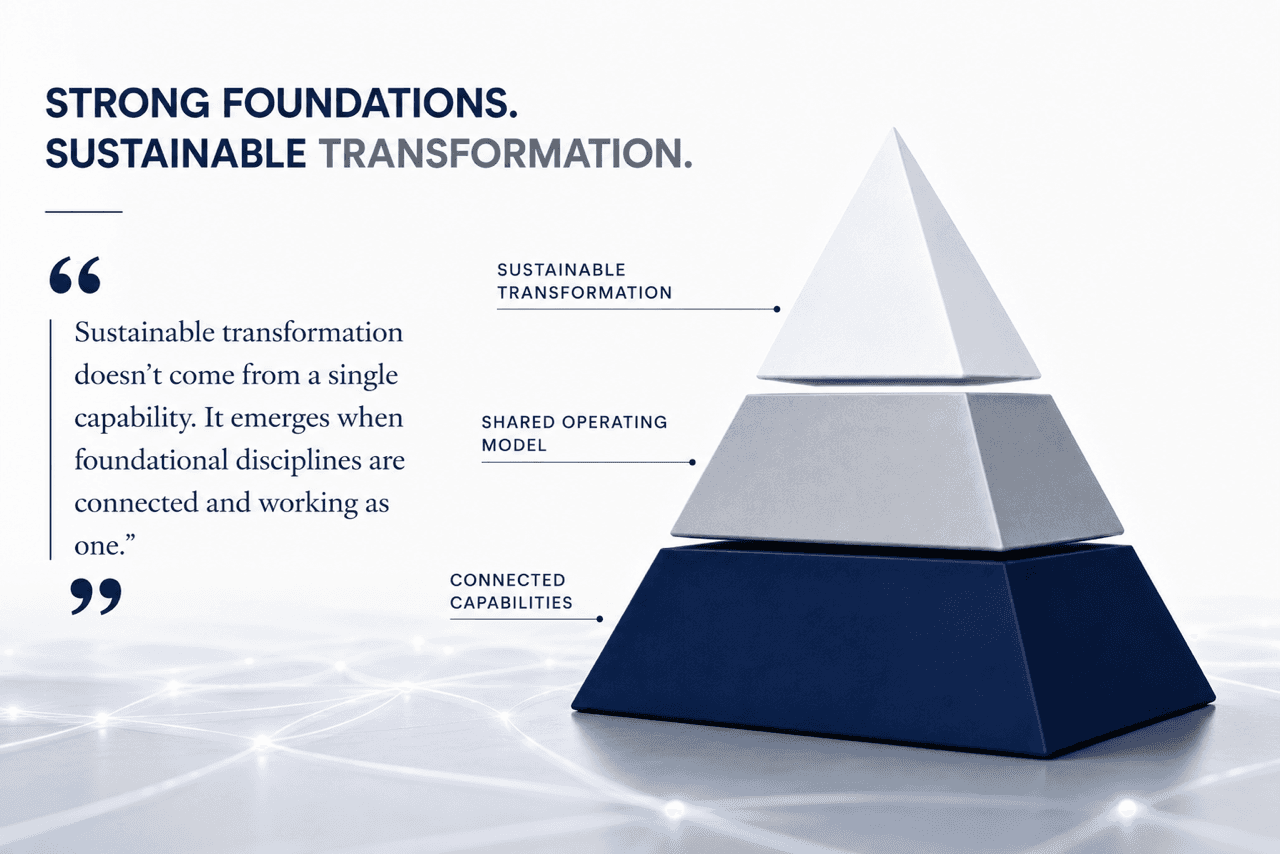
Transformation does not fail because organizations attempt too much. It fails because the connections between strategy, governance, delivery, data, process, and people are weak. Sustainable change begins by strengthening those connections.
Every transformation depends on the same foundations.
Whether the objective is AI adoption, modernization, regulatory compliance, cost reduction, or organizational redesign, the same capabilities determine success. Leaders need governance that enables decisions rather than bureaucracy. They need trusted data that provides context instead of conflicting reports. They need delivery practices that expose risk early, portfolio management that clarifies priorities, and operating models that support new ways of working instead of preserving old ones.
Treat these as separate disciplines and transformation becomes fragmented. Treat them as one connected system and each capability strengthens the next.
AI exposes the strength of the organization.
AI does not remove organizational complexity. It reveals it. Weak governance produces inconsistent decisions. Poor data produces unreliable insight. Fragmented delivery creates competing priorities. Undefined processes create unnecessary variation. Unclear accountability slows adoption regardless of how capable the technology becomes.
Organizations with connected foundations adopt AI faster because the conditions for change already exist. Organizations without those foundations simply expose their weaknesses more quickly. AI is an amplifier. It magnifies the strengths and weaknesses that already exist inside the organization.
Connected leadership creates sustainable change.
Transformation cannot be governed through disconnected steering committees, isolated roadmaps, or competing investment decisions. Strategy, portfolio management, business architecture, governance, delivery, workforce readiness, and operational performance should reinforce one another through a single management system.
When these disciplines operate together, leaders gain clarity. Decisions become faster. Dependencies become visible earlier. Resources are directed where they create the greatest value. Change becomes something the organization can absorb rather than endure. That is how transformation becomes sustainable.
Build foundations, not initiatives.
Every transformation eventually reaches the same question: Can the organization absorb this change? The answer is rarely found in a project plan. It is found in the quality of the foundations supporting every initiative.
Organizations that connect strategy, governance, data, delivery, process, and people build an operating model capable of continuous change. Organizations that do not simply repeat the cycle of launching one transformation after another. Sustainable transformation is not built initiative by initiative. It is built foundation by foundation.