Perspective
Why AI Adoption Is an Operating Model Decision
AI creates value only when leadership, governance, decision-making, delivery, and workforce practices change with it.
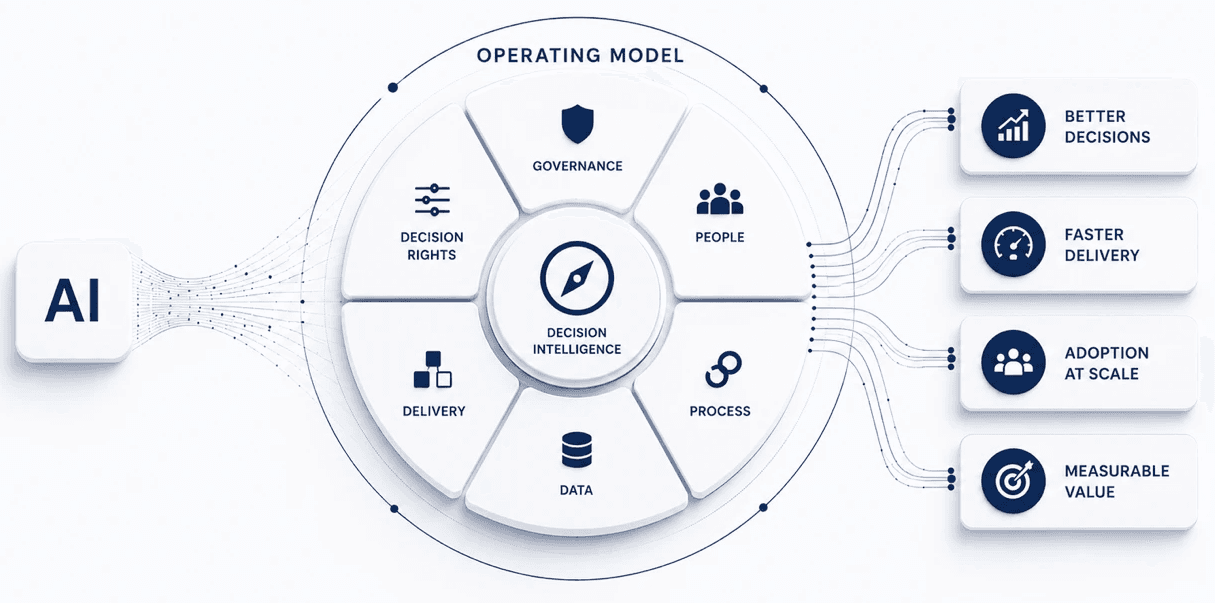
AI adoption is an operating model decision.
AI adoption is often framed as a technology decision. Select a platform, identify use cases, establish controls, and encourage teams to experiment. That sequence is understandable, but incomplete. The central question is whether leaders are prepared to change how decisions are made, work is designed, risk is governed, and value is measured. Those are operating model questions. Until they are treated as such, AI remains a promising capability looking for a place to matter.
AI changes the economics of judgment, information access, and coordination. It can reduce the effort required to prepare a decision, but it also raises the standard for the decision itself. It can make expertise more available, but it requires leaders to clarify where accountability remains human. It can accelerate delivery, but only when teams understand which controls protect quality and which merely slow work down.
The operating model makes adoption real.
An operating model clarifies decision rights, roles, governance, management rhythms, service boundaries, and measures of performance. AI adoption succeeds when these elements evolve together. A team cannot use AI responsibly if data ownership is unclear. A leader cannot demand scaled adoption if workforce expectations remain undefined. A portfolio cannot prioritize investment intelligently if it cannot distinguish experimentation from an initiative ready to change operational outcomes.
The most useful programs begin with a practical examination of work. Which decisions consume disproportionate time? Where does information arrive late or without context? Which handoffs create rework? Where does expertise sit in a few individuals rather than in repeatable systems? These questions identify the constraints AI may help address. They also reveal the constraints AI cannot solve: unclear priorities, weak governance, inconsistent data, and leaders who have not agreed on what better work should look like.
Governance must enable judgment.
Good governance gives people a clear path to act. It establishes who can approve a use case, what evidence is needed to assess risk, which data may be used, how outcomes will be monitored, and when a solution should be stopped. Its purpose is not to create more meetings. It is to replace uncertainty with disciplined judgment. This has to be reflected in portfolio choices, investment criteria, performance conversations, and the routines through which leaders review progress.
Adoption is also a workforce and delivery discipline. People need to understand how a capability changes their work, why it improves the outcome, what judgment remains theirs, and where to go when an answer is uncertain. Teams need time to redesign workflows, test assumptions, and establish new quality practices. Delivery leaders need to measure usage alongside operational impact. Accounts created, tools launched, and training completed do not establish value.
AI adoption becomes durable when organizations build the ability to learn in public. Leaders make results visible, share what did not work, adjust controls as evidence develops, and give teams permission to improve the work rather than defend an original plan. The executive question is not where AI can be deployed. It is what must change in the way the organization operates for AI to create value. The answer will involve data, governance, leadership, delivery, and people.
The executive mandate is to make this change concrete. Define the business outcome, the decision or workflow that must improve, the accountable leader, and the evidence that will demonstrate progress. Then use the portfolio to sequence work around those conditions. This prevents AI from becoming an isolated innovation program and keeps attention on the management practices that allow a new capability to be absorbed.
That approach is evidence-based in the most practical sense. Teams should begin with a hypothesis about how work will improve, test it in a bounded setting, measure the result, and adjust the operating conditions before scale is attempted. Leaders should ask what new behaviors are being adopted, what controls have become clearer, and where the organization is gaining time, quality, resilience, or decision confidence.
The value of AI will be determined by the quality of the organization that uses it. Where leadership is aligned, information is connected, governance is proportionate, and delivery is disciplined, adoption can strengthen the way work gets done. Where those foundations are weak, AI will expose the weakness faster. That is why AI adoption belongs on the operating model agenda.
AI does not replace an organization’s operating model. It amplifies the strengths and exposes the weaknesses already present in how decisions are made, work is designed, information is governed, and accountability is sustained. That is why AI adoption is an operating model decision. Organizations do not become AI-enabled by deploying AI. They become AI-enabled by changing how they work.